


What is Neurofeedback?

Neurofeedback is a non-invasive method designed to enhance brain health through brain training techniques. While many are familiar with biofeedback for managing stress in the body, neurofeedback focuses on real-time brain training to optimize mental health treatment. It effectively addresses brainwave dysregulation, which can contribute to issues like ADD/ADHD, OCD, anxiety, insomnia, depression, migraines, and more.
There are four primary types of brainwaves: Delta, Theta, Alpha, and Beta. These brainwaves interact to maintain balance within the body and mind. When one or more of these brainwaves is imbalanced, it can adversely affect both mental and physical health.
What conditions does neurofeedback help?
Below is a list of some conditions that neurofeedback has shown to be clinically responsive to through research, highlighting its potential in brain training and mental health treatment:
+ADD/ADHD
+Addiction
+Anxiety
+Brain Injury
+Chronic Pain
+Depression
+Insomnia
+Memory Loss
+Migraines
+OCD
+PTSD/Stress
+Sleep Disorders
What do appointments look like?
When you reach out to us for brain training or mental health treatment, we’ll schedule your initial appointment and gather some background information from you. You’ll be asked to complete a few assessments and electronically sign necessary paperwork prior to your first visit.
The Initial Appointment (qEEG):
During this appointment, we'll perform a qEEG (Quantitative Electroencephalogram) or Brain Map. This process allows us to assess which brainwaves may be out of balance and examine the brain's cortical electrical activity, which is essential for effective brain training. We use two different reports to analyze the brainwave patterns, and you'll receive a copy of the summary report for your reference, supporting your mental health treatment journey.
The Second Appointment (Interpretation):

During this appointment, we'll go over the results of your qEEG and explain our findings related to your mental health treatment. We'll also outline your personalized treatment plan and provide you with a color copy of the clinical report. If time permits, we’ll set you up for a 10 to 15-minute brain training session to further support your progress.
The Third Appointment and Beyond (Brain Training Sessions):
Brain training sessions, essential for effective mental health treatment, typically last 20–30 minutes. While most sessions are 30 minutes long, some patients prefer shorter durations of 20 or 25 minutes if they feel fatigued.
During each brain training session, your clinician will attach sensors to your ears and head. For eyes-open training, you’ll watch a calming video, while for eyes-closed sessions, you can listen to music of your choice.
The training utilizes operant conditioning, providing your brain with positive feedback when it stays within desired ranges during visual or audio cues. This method is simple and non-invasive. Some individuals notice immediate improvements, whereas others might begin to see changes after 10–15 sessions. The number of brain training sessions required varies depending on the specific condition being treated.
Frequently Asked Questions

Will neurofeedback therapy change my personality?
No. Neurofeedback training sessions are designed to enhance your brain’s connections, helping them communicate more efficiently and remain balanced. This mental health treatment can make you calmer, more resilient to stress, and clearer headed. It will not alter your hobbies, interests, or who you fundamentally are.
Will I notice a difference right away?
Most patients experience positive changes after 6-8 brain training sessions, typically completed over 3-4 weeks. Some individuals have reported noticing differences after just the first session.
Are neurofeedback session results long lasting?
Yes. Much like learning a new skill such as riding a bike, our patients usually complete their treatment regimen without needing to return. In fact, after your initial series of brain training sessions, you will continue to observe improvement for up to 12 months after your last session. This is a natural result of your brain utilizing new pathways, which become stronger each time they are engaged.
However, some people choose to continue their neurofeedback therapy periodically as a “tune-up” or return later to tackle new challenges.
Does brain mapping or neurofeedback training sessions interfere with current medications? No. We encourage you to continue taking any medications recommended by your physician. Over time, we will work with you and your prescribing physician to determine if you may be able to reduce or eliminate medications based on your results, especially as you engage in our brain training for improved mental health treatment.
Are there any side effects reported for neurofeedback? No. In the 40 plus years that neurofeedback training has been available, with the exception of fatigue after a session, no side effects have ever been reported. Neurofeedback training utilizes your brain's natural ability to learn, enhancing its efficiency as part of our brain training approach.
Is biofeedback the same as neurofeedback? Neurofeedback is a more specialized type of biofeedback. Biofeedback refers to a training technique where a person learns to regulate certain body functions, such as heart rate, blood pressure, or in this case, brain wave patterns. Neurofeedback can also be called neurotherapy, neurobiofeedback, and EEG biofeedback, all contributing to effective mental health treatment.
What types of patients do you treat? We treat children ages 5 and older and adults who are seeking relief from ADD/ADHD, anxiety, autism, bipolar disorder, concussion or brain injuries, depression, insomnia, migraines, PTSD or trauma, seizures or epilepsy, and for those wanting to improve their performance or handle stress better through our brain training methods.
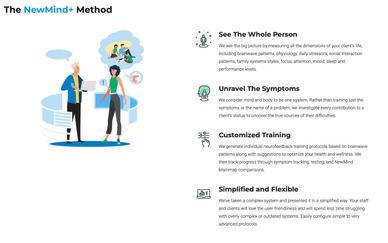
We are a NewMind clinic dedicated to providing effective brain training and mental health treatment. To explore more about the software and equipment we use, simply click the NewMind button below. We encourage you to take some time to review the resources and learn about the conditions that neurofeedback can help with. The website contains valuable information that can answer many of your questions.